INCOME & CASH
Income support programs—including cash assistance and tax credits— help families meet their basic needs and promote economic mobility. We champion policies such as a living wage, direct cash assistance, and progressive tax credits to provide economic stability.
Publication Types
Topics
Authors

For millions of Americans, public benefits play a critical role in helping make ends meet, but the way these benefits cut off as income rises can mean families face a financial setback when their earnings increase. This brief explains what benefits cliffs are and shares recommendations with policymakers for creating clear, understandable step-downs in benefits programs to help families translate increased earnings into increased financial security.

Poverty statistics shape how policymakers and the public understand economic hardship and the role public programs play in helping families meet basic needs. Recent Congressional calls for changes to how poverty is measured would ignore best practices and disguise the hardship that families experience. This blog post argues that misleading statistics could be used to support policies that gut public benefits programs, which would harm millions of people in low- and moderate-income families.
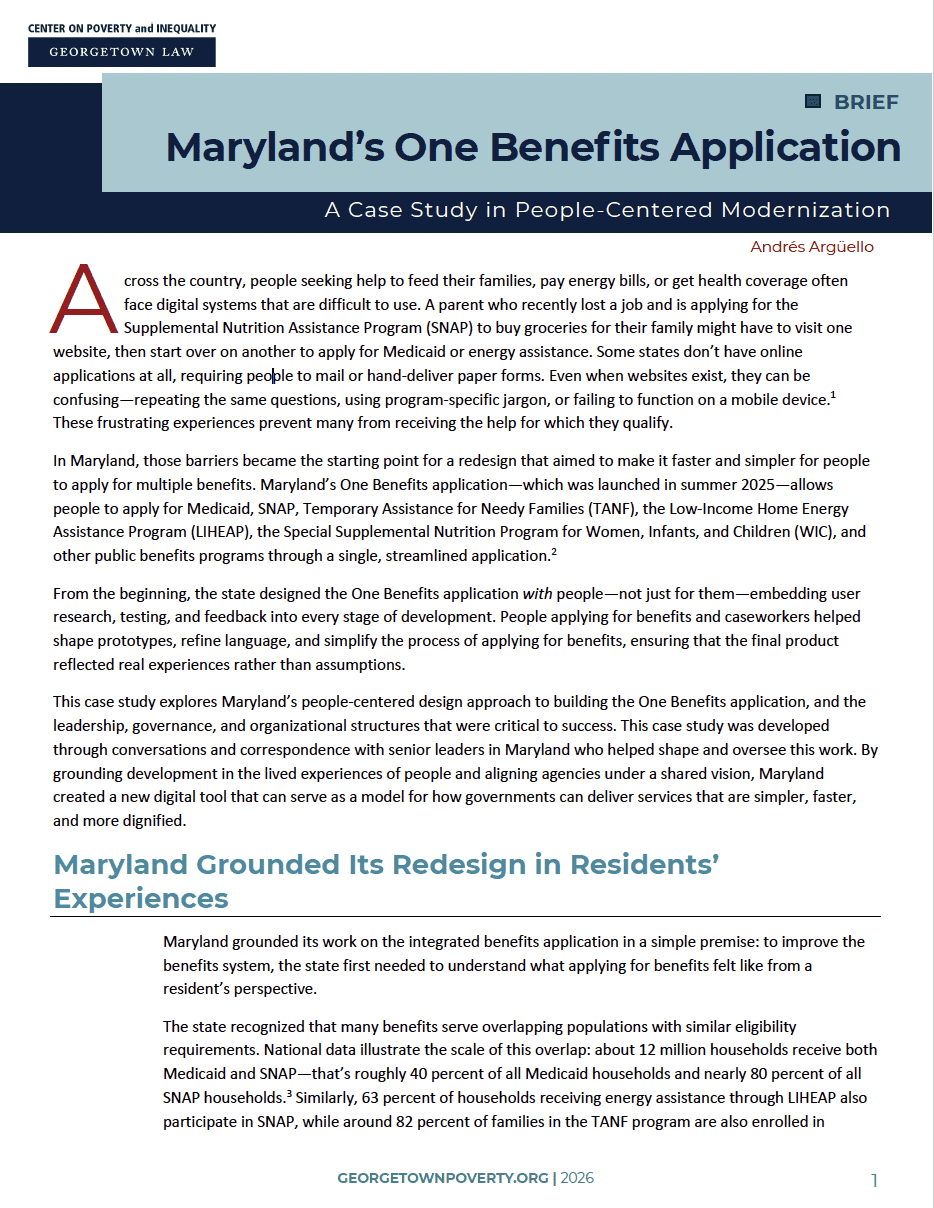
Millions of Americans rely on public benefits to meet daily needs, yet unnecessary barriers and outdated technology too often make accessing help a struggle. GCPI’s People-Centered Digital Benefits Project highlights state innovations for modernizing benefits delivery systems to meet people’s needs.
In this case study, Visiting Fellow Andrés Argüello explores Maryland’s people-centered design approach to building the One Benefits application—which allows people to apply for multiple public benefits programs through a single, streamlined application—and the leadership, governance, and organizational structures that were critical to success.
Millions of people rely on public benefits programs to meet their basic needs, but outdated systems can make it difficult for families to access support. As states work to modernize public services, people-centered design offers a promising approach. Understanding how states translate principles into practice is essential for policymakers and administrators to create more effective public benefits systems.
This case study, part of the Georgetown Center on Poverty and Inequality’s People-Centered Digital Benefits Project, highlights how the state of New York’s Office of Customer Experience is transforming service delivery by embedding customer-centered design across state agencies. This brief explores the leadership structures, community partnerships, and human-centered design practices that helped New York redesign Medicaid renewals, modernize WIC outreach, and streamline child care assistance – offering lessons and practical strategies for other states.

At some point in our lives, nearly all of us will need to take time away from work to address a loved one’s or our own serious illness, or to welcome a new child. Paid leave policies support better health and child development outcomes for workers and children, and ensure the financial stability of workers, their families, and their employers. But too many workers lack access to paid leave. As states step up to fill the gaps, federal policy can help states expand access and strengthen programs. These two fact sheets examine recent federal proposals and show how federal–state partnership approaches would expand access to paid leave.
Federal-State Partnerships to Expand Paid Family and Medical Leave estimates how many workers – including low-paid workers – stand to benefit if paid leave policies such as the More Paid Leave for More Americans Act and the I-PLAN Act of 2025 are passed.
House Bipartisan Working Group on Paid Leave Legislation breaks down how the More Paid Leave for More Americans Act and the I-PLAN Act of 2025 proposals would improve access to paid family leave and harmonize existing state paid family leave programs.
January is National Poverty in America Awareness month, offering an opportunity to reflect on the policy choices the United States government does or does not make to ensure that economic opportunity is a right, hardship and instability are the exception, and children have what they need to reach their full potential. In this blog post, GCPI highlights important but perhaps less well-known facts about who experiences poverty in the United States, and which proven policy solutions, such as the Child Tax Credit, could dramatically reduce poverty.
Millions of Americans rely on public benefits to meet daily needs, yet unnecessary barriers and outdated technology too often make accessing help a struggle. GCPI’s People-Centered Digital Benefits Project highlights state innovations for modernizing benefits delivery systems to meet people’s needs.
Massachusetts offers a particularly powerful example of people-centered public benefits modernization. In this case study, Visiting Fellow Andrés Argüello profiles the creative, multi-pronged effort of the Massachusetts Digital Service to build public-sector capacity across state government. Massachusetts is helping state agencies improve their digital services and ensuring that the people designing and overseeing delivery of digital benefits are the same people who hear from residents, spot system failures, and are held accountable for fixing them.
The Child Tax Credit is designed to help families afford the increasingly high costs of raising children. This analysis explores how different types of families fare under the rules today, examining issues relating to eligibility, refundability, and child claiming rules that can keep families from getting the support they need. The stories in this post show the need for changes to the tax code to better reflect the realities of families today.
A provision in the Budget Reconciliation package would require precertification for the Earned Income Tax Credit (EITC), delaying refunds and creating audit-like hurdles for millions of low-income families. The change targets those who earn the least, while leaving far larger sources of revenue—like wealthy individuals and corporations—untouched.

The Supplemental Nutrition Assistance Program (SNAP) and Medicaid provide support to nearly one-third of people in our country. The reconciliation bill passed by the House in May 2025 takes away $1 trillion in food & health care from families participating in SNAP and Medicaid, while giving roughly the same amount of money in tax cuts to families with incomes above $500,000. This fact sheet examines the unfair trade-offs made in the House-passed reconciliation bill, showing that the bill will exacerbate already extreme levels of income inequality across every state.
The workbook contains all statistics and information underlying the figures, including state-by-state data.